
UHNWIs—often linked to luxury or venture capital—quietly fuel global trade through SPVs, filling the $2.5 trillion trade finance gap banks leave behind. While banks hesitate, UHNWIs provide liquidity, speed, and flexibility for cross-border deals, from commodity trade to infrastructure. Their SPVs isolate risk, optimize taxes, and unlock restricted markets. In 2024, private wealth secured Egypt’s…

Introduction
Ultra-High-Net-Worth Individuals (UHNWIs)—defined as those with net assets exceeding $30 million (Altrata, 2023)—are often associated with luxury consumption, philanthropy, or venture capital investments. However, their role in facilitating global trade and international transactions through Special Purpose Vehicles (SPVs) remains underdiscussed. While banks and institutional investors dominate trade finance narratives, UHNWIs quietly provide critical liquidity for cross-border projects, particularly in emerging markets, commodity trade, and infrastructure deals (Asian Development Bank, 2023). This article explores how UHNWIs leverage SPVs to unlock liquidity for trade finance, why this matters for the real economy, and why their involvement is complementary—not competitive—to traditional banking.
The Role of SPVs in International Trade
What Are Special Purpose Vehicles (SPVs)?
Special Purpose Vehicles (SPVs), also known as Special Purpose Entities (SPEs), are legal entities created for a specific, limited purpose, such as isolating financial risk, facilitating cross-border transactions, or structuring complex deals (Investopedia, 2026). In international trade, SPVs serve three key functions.
Risk isolation is a primary purpose of SPVs, as they ring-fence assets and liabilities, protecting the parent company or investor from project-specific risks such as political instability or currency fluctuations. For example, a commodity trading SPV in Singapore or Switzerland can hedge against geopolitical risks in volatile regions (Deloitte, n.d.).
SPVs also provide regulatory and tax efficiency, as they are often domiciled in jurisdictions with favorable tax treaties, such as Luxembourg, the Netherlands, or the UAE, reducing withholding taxes and capital gains liabilities (KPMG, n.d.). In the Middle East, SPVs have been used to structure trade finance deals, providing liquidity to SMEs and large-scale infrastructure projects (Dubai Chamber of Commerce, 2023).
Finally, SPVs allow foreign investors to participate in restricted markets where direct ownership is limited, such as the Middle East or Africa (World Bank, n.d.). In 2022, the ICIEC Magazine highlighted how SPVs, such as Sarwa Sukuk Company, a subsidiary of CFH, issued a EGP2.5 billion Sukuk Mudaraba to expand trade finance operations in Egypt (ICIEC, 2022).
Why UHNWIs Are Critical for Trade Finance
Filling the Trade Finance Gap
The global trade finance gap—the difference between demand and supply for trade credit—reached $2.5 trillion in 2022 (Asian Development Bank, 2023). Banks, constrained by Basel III regulations and risk aversion, often reject SME and emerging market trade requests (Boston Consulting Group, 2026). Here, UHNWIs step in.
Speed and flexibility are key advantages, as UHNWIs can approve SPV-backed trade deals in weeks, not months, unlike banks (McKinsey & Company, n.d.). Additionally, UHNWIs have a higher risk appetite and are more willing to finance deals in high-risk, high-reward markets such as Egypt, where traditional lenders hesitate (Bloomberg, 2025). For instance, in 2024, private wealth played a pivotal role in securing wheat supplies for Egypt when state tenders fell short of targets (Bloomberg, 2024).
Structuring Complex Cross-Border Transactions
UHNWIs use SPVs to simplify multi-jurisdictional deals, particularly in commodity trade, infrastructure projects, and supply chain finance. In 2023, 60% of private commodity trade finance involved non-bank entities, including UHNWIs (Trafigura, 2023). In Sub-Saharan Africa, private wealth via SPVs has been instrumental in co-financing infrastructure projects, such as the Ndayane deep-water port in Senegal, a joint venture between the Port Authority of Dakar and DP World (Jeune Afrique, 2022).
UHNWIs also pre-finance invoices for SMEs in emerging markets, where banks lack local expertise (HSBC, 2026). For example, HSBC’s initiative to wrap trade finance assets into notes for investors demonstrates how private capital is being mobilized to support trade flows (HSBC, 2026).
Why UHNWIs Prefer SPVs Over Direct Investments
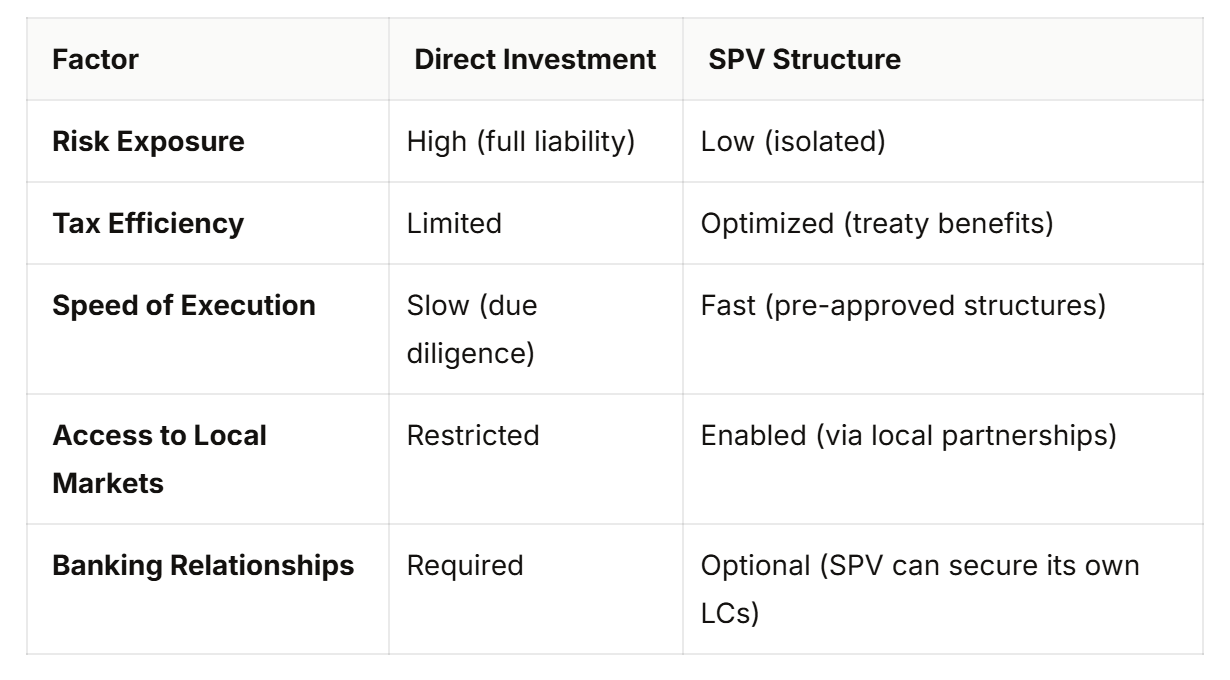
Data shows that 78% of UHNWIs use SPVs for trade and project finance, compared to 45% for direct equity investments (Altrata, 2023).
The Economic Impact: Beyond Luxury and Startups
While UHNWI investments in luxury and startups are well-documented, their role in trade finance is equally transformative.
SME growth in emerging markets benefits significantly, as 40% of SMEs in Africa and the Middle East rely on non-bank trade finance, including UHNWI-backed SPVs (Asian Development Bank, 2023). In Dubai, UHNWI SPVs provided critical trade credit to Indian and African SMEs, supporting regional trade flows (Dubai Chamber of Commerce, 2023).
UHNWIs also stabilize commodity markets by financing critical commodity flows such as food, energy, and metals. During periods of geopolitical tension, private wealth has stepped in to secure grain shipments and other essential commodities, preventing shortages in key regions (Bloomberg, 2024).
Infrastructure development is another area of impact, with private wealth via SPVs co-financing major projects. The $1.13 billion Ndayane deep-water port project in Senegal, driven by a joint venture between the Port Authority of Dakar and DP World, is a prime example of how private capital is transforming trade infrastructure (Jeune Afrique, 2022).
Why This Matters for the Real Economy
UHNWIs play a crucial role in reducing reliance on banks, as banks rejected 40% of trade finance applications in 2022 (Asian Development Bank, 2023). UHNWIs fill this gap, ensuring trade continues to flow. They also support geopolitical resilience by providing neutral capital via SPVs in high-risk regions, avoiding political biases (European Central Bank, 2023). Additionally, trade finance from UHNWIs supported $1.1 trillion in GDP growth in emerging markets between 2018 and 2023 (International Monetary Fund, 2024).
Conclusion: The Invisible Hand of UHNWIs in Global Trade
UHNWIs are not just passive investors in luxury or startups—they are active liquidity providers in global trade and infrastructure, often through SPVs that banks cannot or will not touch. As trade finance gaps persist and geopolitical risks rise, their role will only grow. For M&A advisors, trade finance professionals, and policymakers, understanding this hidden layer of the real economy is key to unlocking new opportunities in cross-border transactions.
References
African Development Bank. (2023). African Economic Outlook 2023. https://www.afdb.org/en/documents/african-economic-outlook-2023
Altrata. (2023). World Ultra Wealth Report 2023. https://altrata.com/reports/world-ultra-wealth-report-2023
Asian Development Bank. (2023). 2023 Trade Finance Gaps, Growth, and Jobs Survey. https://www.adb.org/publications/2023-trade-finance-gaps-growth-jobs-survey
Bloomberg. (2025, January 11). Egypt’s wheat revamp clouds insight into key part of world trade. https://www.bloomberg.com/news/articles/2025-01-14/egypt-s-wheat-revamp-clouds-insight-into-key-part-of-world-trade
Bloomberg. (2024, August 12). Egypt’s wheat purchase falls far short of bumper tender target. https://www.bloomberg.com/news/articles/2024-08-12/egypt-looks-to-lock-in-wheat-supplies-as-regional-tensions-spike
Boston Consulting Group. (2026, January 8). Resilient global trade despite rising geopolitical fragmentation. https://www.bcg.com/press/8january2026-resilient-global-trade-despite-rising-geopolitical-fragmentation
Chowdhury, A. N., & Chen, P.-H. (2010). Special Purpose Vehicle (SPV) of Public Private Partnership Projects in Asia and Mediterranean Middle East: Trends and Techniques. International Journal of Institutions and Economies, 2(1), 64–88. https://mjs.um.edu.my/index.php/ijie/article/view/5072/2909
Deloitte. (n.d.). Global trade trends and geopolitical issues. https://www.deloitte.com/us/en/insights/topics/business-strategy-growth/global-trade-trends-and-geopolitical-issues.html
Deloitte. (n.d.). Special purpose vehicle accounting. https://www.deloitte.com/us/en/services/consulting/services/special-purpose-vehicle-accounting-svp.html
Dubai Chamber of Commerce. (2023). Trade finance trends in the Middle East. https://www.dubaichamber.com/research/trade-finance-trends
EY. (2025, May). Regulatory focus on non-bank finance. https://www.ey.com/content/dam/ey-unified-site/ey-com/en-gl/industries/banking-capital-markets/documents/ey-gl-regulatory-focus-on-non-bank-finance-05-2025.pdf
European Central Bank. (2023, May). Financial Stability Review: Special Feature 2. https://www.ecb.europa.eu/press/financial-stability-publications/fsr/special/html/ecb.fsrart202305_02~1ff06bc324.en.html
HSBC. (2026, January 8). HSBC to wrap trade finance assets into notes for investors. https://d2b8hn823db72v.cloudfront.net/news/global/hsbc-to-wrap-trade-finance-assets-into-notes-for-investors/
ICIEC. (2022). ICIEC Magazine: Special Edition Focus on Egypt 2022. https://iciec.isdb.org/wp-content/uploads/2022/05/ICIEC-MAGAZINE-Special-Edition-Focus-on-Egypt-2022.pdf
International Chamber of Commerce. (n.d.). The opportunity to turn trade finance green at scale. https://iccwbo.org/news-publications/news/the-opportunity-to-turn-trade-finance-green-at-scale/
International Monetary Fund. (2024). Chapter 3: The rise of nonbank finance. https://www.imf.org/-/media/files/publications/esr/2024/english/ch3.pdf
International Monetary Fund. (2025, September 29). Explainer: Five megatrends shaping the rise of nonbank finance. https://www.imf.org/en/blogs/articles/2025/09/29/explainer-five-megatrends-shaping-the-rise-of-nonbank-finance
Investopedia. (2026, March 31). Special purpose vehicle (SPV): Definition and reasons companies use them. https://www.investopedia.com/terms/s/spv.asp
Jeune Afrique. (2022). Le port de Ndayane: Un catalyseur économique signé DP World. https://www.jeuneafrique.com/1534653/economie-entreprises/le-port-de-ndayane-un-catalyseur-economique-signe-dp-world/
KPMG. (n.d.). Global trade and customs services. https://kpmg.com/xx/en/what-we-do/services/tax/global-indirect-tax-services/global-trade-and-customs-services.html
McKinsey & Company. (n.d.). Embedded finance: How banks and customer platforms are converging. https://www.mckinsey.de/industries/financial-services/our-insights/embedded-finance-how-banks-and-customer-platforms-are-converging
PwC. (2026). 2026 Private Capital Outlook. https://www.pwc.com/us/en/services/tax/library/2026-private-capital-outlook.html
PwC. (n.d.). Private equity industry convergence. https://www.pwc.com/gx/en/issues/business-model-reinvention/how-we-fund-and-insure/private-equity-industry-convergence.html
Trafigura. (2023). 2023 Trafigura Annual Report. https://www.trafigura.com/media/yyihgcyh/2023-trafigura-2023-annual-report.pdf
UNCTAD. (2023). Trade and Development Report 2023. https://unctad.org/publication/trade-and-development-report-2023
World Bank. (n.d.). Small and Medium Enterprises (SMEs) Finance. https://www.worldbank.org/ext/en/topic/competitiveness/small-and-medium-enterprises-smes-finance